

Start with a clean baseline before you change anything
Before you adjust your recipe, clean the grinder, basket and shower screen, then use fresh beans that are not too old. Espresso is small and concentrated, so stale coffee, oily buildup or a damp portafilter can throw everything off. In a Cape Town kitchen with coastal humidity, beans can age faster than you expect, while in Johannesburg the dry air can make them behave a little differently from one week to the next.
Begin with one coffee and keep it there for a few days. If you change beans, grind size and milk at the same time, you will not know what actually improved. A simple baseline makes the rest much easier.
- Use beans that rested at least 7 to 14 days after roasting.
- Wipe the basket dry before dosing.
- Run a short water flush if the machine has been idle.
- Keep notes on dose, yield, time and flavour.
Set your dose and yield to a simple ratio
For most home espresso, a good starting point is 18 g in the basket and 36 g in the cup, which gives a 1:2 ratio. That means every gram of coffee in the basket gives about two grams of liquid espresso out. Some coffees open up at 1:1.8, others taste cleaner at 1:2.2, so this is a starting point not a rule carved in stone.
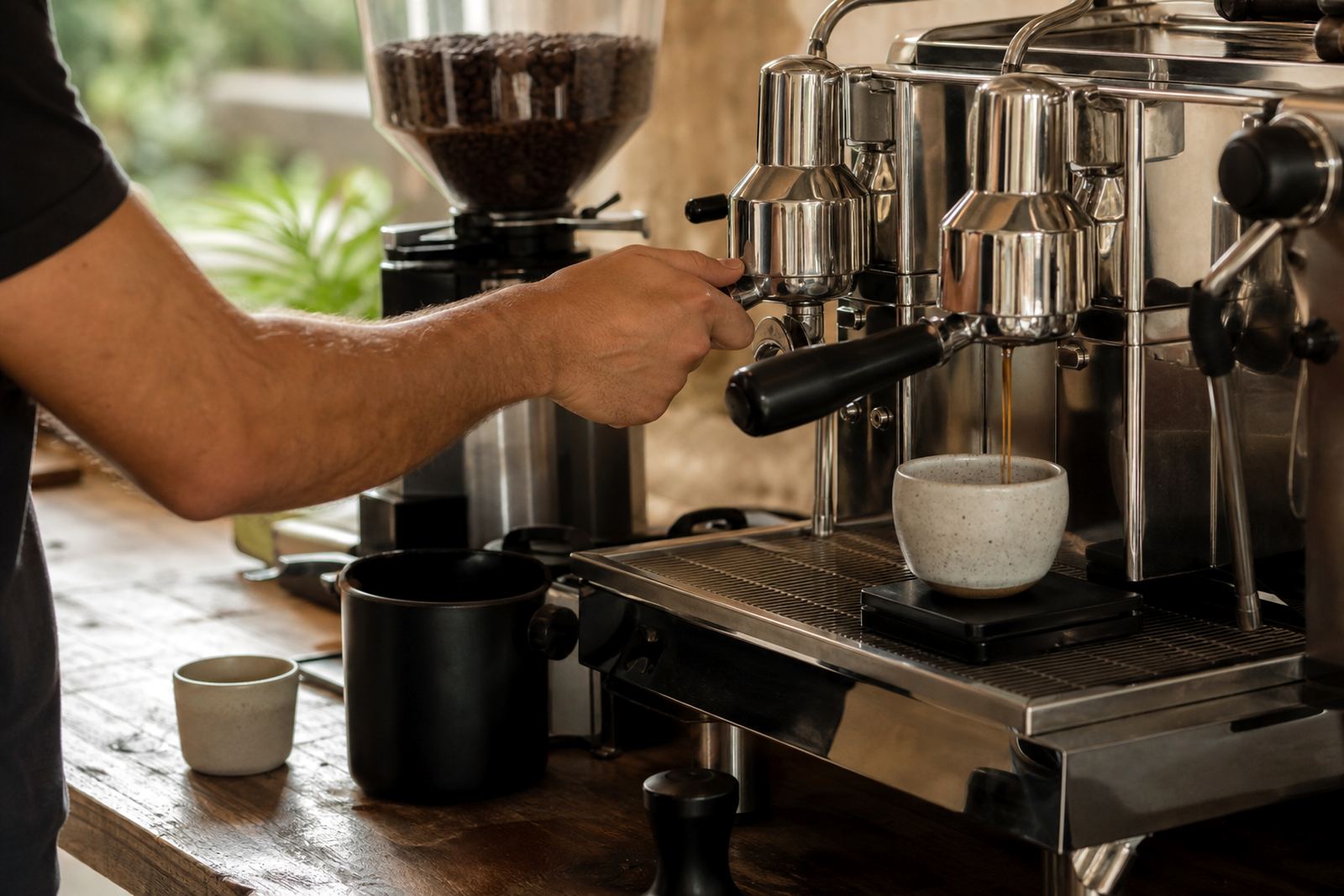
Use a scale under the cup and weigh the shot as it runs. If the shot tastes thin and sharp, shorten the yield slightly. If it tastes heavy or bitter, try a touch more yield before you move the grind too far. Small changes work best, maybe 1 g at a time on dose or 2 to 4 g on yield.
- Starter recipe: 18 g dose, 36 g yield.
- Shorter shot: 18 g dose, 32 to 34 g yield.
- Lighter, brighter shot: 18 g dose, 38 to 40 g yield.
- Change only one variable at a time.
Watch the shot time, not just the clock on the wall
A useful target for many home setups is 25 to 30 seconds from first drip to finished yield, but the time only matters when it matches the taste. A shot that runs in 20 seconds can still work if the coffee is light and bright, while a 35 second shot may be fine if the grind is fine enough and the flavour stays balanced. Time is a guide, not the goal.
If the espresso gushes through too quickly, the grind is probably too coarse or the puck is poorly prepared. If it barely drips or chokes the machine, the grind is too fine, the dose is too high, or the coffee is tamped unevenly. A few small adjustments are enough, no need to chase perfection in one go.
- Too fast: grind finer, then test again.
- Too slow: grind coarser or reduce the dose a little.
- Uneven channeling: level the coffee before tamping.
- Record the brew time with each change.
Dial in the grinder with small, repeatable steps
The grinder does most of the work. If the shot tastes sour, weak or thin, move finer. If it tastes harsh, dry or overly bitter, move coarser. Make one adjustment at a time and pull another shot before deciding. On some grinders one notch can be too much, so if the settings are very sensitive, use half-steps where possible.
Puck prep matters too. Tap the portafilter gently to settle the coffee, level the surface, then tamp straight and firm. You do not need to press as hard as you can, you just need a flat, even puck. That helps the water move through evenly instead of finding a weak spot and rushing through it.
- Grind finer for faster or weaker extractions.
- Grind coarser for slower or harsher extractions.
- Level the dose before tamping.
- Keep the same tamp pressure every time.
Taste for balance and adjust one thing at a time
Once the shot lands in the right time window, taste it plain before adding milk. Good espresso should feel sweet, rounded and clean on the finish. If it tastes sour, the coffee may be under-extracted and need a finer grind, a longer time or a slightly higher yield. If it tastes bitter or dry at the back of the mouth, the shot may be over-extracted and need less time or a coarser grind.
It helps to think in three parts: first sip, middle and finish. Good espresso often starts with a little brightness, then moves into sweetness and ends clean. If the finish lingers with a drying edge, something is off in the grind, temperature or yield. Keep notes, because memory gets fuzzy after the third cup.
- Sour or sharp: finer grind or slightly longer yield.
- Bitter or dry: coarser grind or shorter yield.
- Watery: increase dose or tighten the ratio.
- Heavy and muddled: check freshness and clean the machine.
Keep a practical routine for home, office and load-shedding days
A steady routine saves time in homes and office kitchens across Cape Town, Johannesburg, Pretoria, Durban and Gqeberha. Keep beans sealed, store them away from heat and do a quick flush before each session. If you are brewing during load shedding, let the machine come fully back to temperature before pulling a shot, because half-warmed equipment gives inconsistent results. In hotter coastal areas, keep milk cold and do not leave the grinder hopper full for days.
If you make coffee for a small team, set one standard recipe and stick to it for the week. That makes stock forecasting easier and helps everyone learn what good espresso should taste like. A clear routine also helps with early morning service, meeting room coffee and busy hospitality service when the pressure is on.
- Store beans in a cool, dry cupboard.
- Warm the cup before brewing if possible.
- Flush and wipe the group head after each shift.
- Reset the grinder after weather or bean changes.